
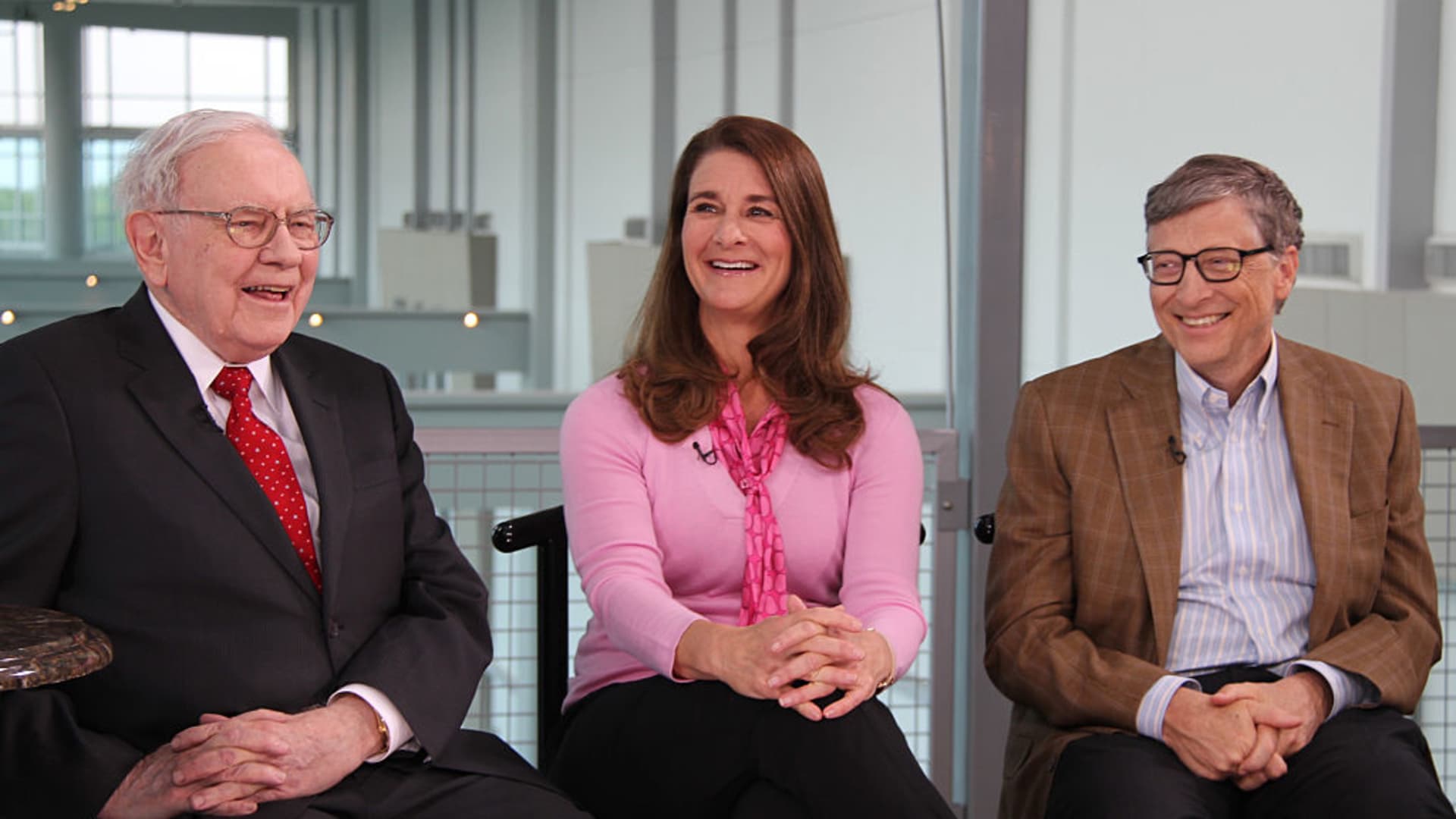
Buffett defends ‘Giving Pledge’ against Thiel and ‘billionaire backlash’

Warren Buffett, Bill and Melinda Gates
Lacy O’Toole | CNBC
But in a major article this week, the Times says that over the past two years, “there has been a growing backlash from the billionaires who are its target donors,” including a “quiet campaign by one pro-Trump tech billionaire to destroy it.”
Peter Thiel tells the Times he has privately encouraged around a dozen signers to cancel their pledges. “Most of the ones I’ve talked to have at least expressed regret about signing it.”
Peter Thiel
Adam Jeffery | CNBC
While the Times says Thiel wasn’t involved, Coinbase co-founder Brian Armstrong, “an outspoken crypto executive who now evinces a disdain for liberal politics,” voluntarily left the group in 2024 without a public explanation.
The next year, Oracle’s Larry Ellison, one of the first signers, announced he was “amending” his pledge to give some money to for-profit initiatives that the Pledge doesn’t cover.
More than 250 families are listed on the Giving Pledge’s web site, but the pace of new additions has slowed. In the first five years, 113 joined. That fell to 72 in the second five years, and just 43 signed in the following five years.
The Times quotes Aaron Horvath, a sociologist who has studied the Pledge, as saying it is a “time capsule” of the 2010s that now “feels old school.”
He says billionaires now think, “I can keep my head down and keep making money. I don’t have to put up with this charity charade anymore.”
The Times adds that in an “era of a more voracious capitalism” with “billionaires trending right and getting ahead by embracing an administration that is happy to dole out favors,” many of them believe “the real way to give back is via business success” that boosts the economy.
Brian Armstrong, CEO of Coinbase, speaking on CNBC’s Squawk Box outside the World Economic Forum in Davos, Switzerland on Jan. 21, 2025.
Gerry Miller | CNBC
Another negative for the Pledge, according to the newspaper, is the damage to Gates’ reputation over his connections to Jeffrey Epstein.
Thiel calls the Pledge an “Epstein-adjacent, fake Boomer club,” although the Times notes he has his own ties to Epstein.
The Giving Pledge has also been criticized from the left.
Last summer, a report from the Institute for Policy Studies argued it is “unfulfilled, unfulfillable, and not our ticket to a fairer, better future.”
A Pledge spokesperson called the report “misleading” with incomplete data.
Taryn Jensen, who runs the Giving Pledge for the Gates Foundation, tells the Times, “In its early years, the Giving Pledge helped build norms where few existed. Our goal is to keep building a culture where giving is the norm and to provide the support that helps turn commitment into action.”
And in the Times piece, Ron Conway, described as a venture capitalist close to Bill Gates, rejects accusations the Pledge is “aligned with liberal causes, or is woke, so to speak,” saying it has plenty of conservatives and moderates.
Buffett recalls irritation at commas added to his annual letters
Buffett was also quoted in another major publication this week.
The Wall Street Journal reported on the CEOs who have been inspired by Buffett’s annual letters to shareholders that used wit and personal anecdotes to elevate “a dreary convention of corporate America and set a new standard.”
JPMorgan Chase CEO Jamie Dimon says he always tries to emulate Buffett’s ability to use plain language in explanations of complex financial concepts but concedes “it’s hard.”
“I’m happy when it’s birthed,” he says of his own annual letter.
In a phone interview with the newspaper, Buffett said he found it very hard to accept feedback from former Fortune journalist and personal friend Carol Loomis, who edited his shareholder letters from 1977 to 2024.
“My first reaction would be to get irritated, which is totally inappropriate,” but “that’s the way you get when you’re writing.”
One of his biggest complaints was that Loomis added too many commas.
Now, he says, they play bridge online weekly without any acrimony. “I finally matured a little bit, at 95.”
BUFFETT & BERKSHIRE AROUND THE INTERNET
Some links may require a subscription:
HIGHLIGHTS FROM CNBC’S BUFFETT ARCHIVE
Buffett on charities: ‘Go with your gut’ (2006)
AUDIENCE MEMBER: Would you please help us think through the capital allocation decisions we face when it comes to charitable giving? …
WARREN BUFFETT: It’s tough to give other people advice on that. But, you know, you have to pick the things that are important to you. And, you know, many people — majority in the United States — it’s their church. You know, there’s more money given to churches than anything else.
Many people — very many people — it’s their school, or schools generally.
You know, I think, to a great extent, you should pick whatever gives you the most satisfaction, and that will probably be something that you know, something you’ve, maybe, benefited from yourself.
I look at it a little differently. The amount of funds are different, too, but I like to think of things that are important but that don’t have natural funding constituencies.
But that isn’t something, you know, for millions of people to be following as an example or something.
Nothing wrong with doing something that gives you plenty of personal satisfaction and does some good for other people in the process.
So I would not be reluctant — I would not feel I had to be as objective about that, necessarily, as I was about buying securities or something of the sort. I would, kind of, go where my gut led me and make it something you participate in.
And, like I say, I think if you’re doing it with large sums, you may have some reason, maybe even some obligation, to try and think about where really large sums can have an important impact on a societal problem that might not get attention otherwise. And, you know, that’s, sort of, where my own thinking leads me.
But I would — I would go with something where I felt I knew where the money was going to go and I knew some good was going to come out of it. And maybe, by observing what took place, I could make the next gift more efficient than the last gift and more beneficial.
BERKSHIRE STOCK WATCH
BRK.A stock price: $720,702.06
BRK.B stock price: $480.94
BRK.B P/E (TTM): 15.50
Berkshire market capitalization: $1,036,964,141,358
Berkshire Cash as of December 31: $373.3 billion (Down 2.2% from Sept. 30)
Excluding Rail Cash and Subtracting T-Bills Payable: $369.0 billion (Up 4.1% from September 30)
Berkshire resumed stock repurchases on March 4, 2026.
(All figures are as of the date of publication, unless otherwise indicated)
BERKSHIRE’S TOP EQUITY HOLDINGS – Mar. 20, 2026
Berkshire’s top holdings of disclosed publicly traded stocks in the U.S. and Japan, by market value, based on the latest closing prices.
Holdings are as of September 30, 2025, as reported in Berkshire Hathaway’s 13F filing on November 14, 2025, except for:
The full list of holdings and current market values is available from CNBC.com’s Berkshire Hathaway Portfolio Tracker.
QUESTIONS OR COMMENTS
Please send any questions or comments about the newsletter to me at alex.crippen@nbcuni.com. (Sorry, but we don’t forward questions or comments to Buffett himself.)
If you aren’t already subscribed to this newsletter, you can sign up here.
Also, Buffett’s annual letters to shareholders are highly recommended reading. There are collected here on Berkshire’s website.
— Alex Crippen, Editor, Warren Buffett Watch